Why Calm Rooms Still Need One Honest Sentence
You moved the throw pillow this morning. Repositioned the candle, adjusted the angle of the chair. The room looks exactly the way you intended it to look.
And you still feel something off. Not anxious, exactly, and not unhappy either. Just the quiet sense that something is missing, and it isn't an object.
Calm rooms are not always honest ones. That distance, between what a space looks like and what it actually acknowledges about you, is worth sitting with for a moment.
Why a Calm Room Can Still Feel Empty
Congruence, in psychological terms, refers to the alignment between your inner emotional state and your outer environment. When those two things are close to each other, you feel settled. When they diverge, even beautiful and serene spaces can feel faintly hollow, the visual equivalent of a smile that doesn't reach the eyes.
Research published in Frontiers in Psychology has confirmed that environmental elements, including color, lighting, and visual complexity, directly influence emotional states, cognitive focus, and a sense of social connection. But the relationship runs in both directions. The environment shapes the nervous system, and the nervous system shapes what the environment means to you. A space that doesn't acknowledge where you actually are can feel cold even when it's warm, or empty even when it's full.
This is what happens in rooms that look calm but don't hold anything real. They've been curated for appearance. For what calm is supposed to look like, the neutral palette and the carefully edited objects and the soft lamp in the corner. And something in you knows the difference between appearance and truth.
The room that holds you isn't necessarily the prettiest one. It's the one that says something honest.
What "One Honest Sentence" Actually Means
It doesn't mean putting your feelings on display. It doesn't mean choosing a quote that narrates your current emotional state or announces your inner world to every guest who walks in.
It means letting one thing in your space say something real. Something that acknowledges that you are a person in the middle of something, that life is not always quiet, that your room can know you and is allowed to reflect that.
The difference between a sentence that decorates and a sentence that holds is the difference between words that perform and words that acknowledge. Most quote art performs. It cheers at you, pushes you forward, assures you that you're capable of more. Words that hold do something quieter. They say: you are here. Whatever here looks like, you are here, and this room is with you.
Two of the quietest and most precise words we've ever chosen for a print are "Rest Here." What those two words hold, and why they land differently than a longer phrase, is worth understanding, and explored in Rest Here: Two Words That Carry Permission. But the underlying principle applies to any honest sentence you choose: it works not because it tells you how to feel, but because it acknowledges how you already feel.
If you want a guided way to find yours, Your Anchor Phrase walks you through identifying the sentence that belongs on your wall, one quiet question at a time.
The Blank Wall and What It's Protecting
You've probably been there. You've scrolled through hundreds of prints, added things to a cart, and then closed the tab. You've told yourself you'll figure it out eventually, and meanwhile the wall stays empty.
The blank wall isn't a sign that you don't care about your space. It's almost always the opposite. It's a sign that you care enough not to put something wrong up there. Something that lies to you a little, or talks at you rather than sitting with you, or tries to make you feel a way you're not quite sure you feel.
A 2010 study by researchers at UCLA, published in Personality and Social Psychology Bulletin, found that women who described their homes as cluttered or unfinished showed elevated cortisol levels throughout the day, compared to women who described their homes as restorative. What's worth noting about that finding isn't just the clutter part. It's the "unfinished" part. A space that hasn't yet said what it needs to say carries its own kind of low-grade tension. The nervous system keeps returning to the question the wall hasn't answered yet.
The empty wall is waiting. Not for the most beautiful thing, or the most aspirational thing. For the honest thing.
And here is what's actually true about the objection that art is just words on paper: it's only true of prints that aren't holding anything. The words on your wall are the ones you read when you are alone, when the day is ending and you need something to be still with, when no one else is watching and you are just a person in a room. Choosing them carefully isn't excessive. It's reasonable. It's the same reason you care what music plays in the background when you're tired, or what you read before sleep.
Wholeness Isn't the Absence of Hard Things
What the Wholeness Collection is actually built around: not peace instead of difficulty, but holding all of it together.
Wholeness, as a concept, is not the same as smoothness. An enso circle, drawn in a single brushstroke in Zen practice to represent completeness and the universe, is never a perfect circle. The gesture includes the imperfection. The wholeness is in the continuity of the movement, not in the perfection of any single point along the line.
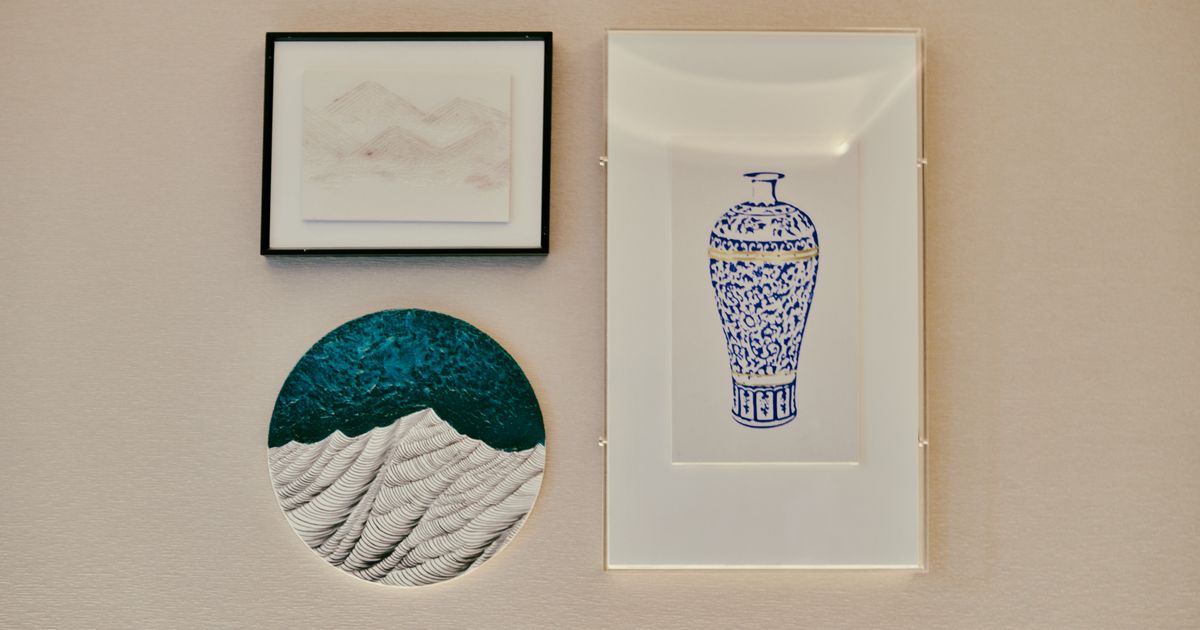
Prints like "Your story matters here" and "Space for all of you" are not aspirational statements about who you're becoming or where you're headed. They are acknowledging ones. They say: bring whatever you're carrying. This room is large enough for all of it, including the parts you haven't finished working through.
That's what an honest sentence does in a calm space. It doesn't break the calm. It makes the calm real. Because calm that doesn't acknowledge anything isn't rest. It's suppression with better lighting.
You can read more about the philosophy behind the collection and what circles have been trying to say for centuries in The Wholeness Collection: What Circles Have Been Trying to Tell Us.
Choosing Art That Holds Something True
The most useful question when you're choosing what goes on your wall isn't whether it looks good. It's whether it says something you want to be reminded of when you're alone with it.
Not something you aspire to feel. Something that acknowledges how you actually feel, and holds it gently, and makes room for what comes next.
The therapeutic home design approach is built around this distinction: not performing wellness but doing the quieter work of holding you. That sometimes means one piece of art. One phrase. One brushstroke on the wall that says: whatever shape you're in right now, you fit here.
If you're working out where to begin, the bedroom is often the right room to start with. What your walls say when you can't say anything yourself is one of the quieter and more important things a space can do, and there's more on that in what your bedroom says when you can't say anything. And if you're thinking about how a room holds emotional experience without directing it, the concept of containment explored in why some rooms feel like a hug is worth sitting with.
One honest sentence. It doesn't need to announce itself. It just needs to say something real.
Frequently Asked Questions
What makes a calm room feel inauthentic?
A room can look visually serene while still feeling emotionally empty if nothing in it acknowledges where you actually are. Psychological research on congruence suggests that wellbeing is highest when your outer environment reflects your genuine emotional experience, not a performed version of calm.
Do honest words on a wall make a room feel heavier?
Honest acknowledgment in your space tends to reduce the weight you carry in silence, not add to it. Naming a feeling, even quietly through a print, gives the nervous system permission to set it down rather than continuing to carry it alone without anywhere to land.
How do I find words that feel true without being heavy?
Look for sentences that acknowledge rather than advise. Words that say "you are here" rather than "you should be there." The ones that make you exhale slightly when you read them are usually the right ones. Avoid prints that tell you how to feel, and look for ones that simply notice that you feel.
Why do quote prints often feel hollow or meaningless?
Most are not holding anything specific. They are generic observations or motivational statements chosen for visual appeal, not emotional precision. A print that holds something is one where someone chose those exact words with a particular emotional territory in mind, and you can feel the difference.
Is one print really enough to change how a room feels?
One anchoring sentence in a space where you spend significant time does more than you expect. The nervous system continuously scans for cues of safety and belonging, and a piece of art that holds something true becomes part of that cue system. The effect compounds over time, the way any familiar and comforting thing does.
What is the Wholeness Collection?
The Wholeness Collection is a set of minimalist art prints built around the emotional territory of self-compassion, acceptance, and integration. The pieces are designed for people who want their space to say: all of you fits here, not just the parts that feel finished or resolved. The geometric signature is the circle, drawn with the imperfection of a real gesture.
The room you are in right now holds more than furniture. It holds how you feel when you are alone, what you let yourself acknowledge when no one is watching, and what you decide is allowed to be true in this particular space.
A calm room is a real thing. But a calm room with one honest sentence in it is something more than calm. It is held.
Take a look at the Wholeness Collection when you are ready. No urgency here. Just see if anything says something that needs to be said.

Written by Haven & Hold