Bathroom Wall Art Ideas That Don't Feel Random
You stand at the sink most mornings and the wall is just there, waiting. Not offensive. Not interesting. The visual equivalent of silence in a room where something should be said.
Most people leave bathroom walls blank not because they don't care, but because they care enough to hesitate. The wrong print feels more jarring in a small, personal space than it would anywhere else in the home. And so the wall stays empty, and every morning you brush your teeth in front of a missed opportunity.
Bathroom wall art doesn't have to be complicated. But it does need intention behind it. Not a matching-set impulse, not a quick scroll, and not whatever was left over from your last apartment. What follows is a guide to choosing art for a space that deserves more credit than it gets, written for anyone who has started looking and closed the tab.
Why Bathroom Walls Stay Blank
Most advice about bathroom wall art falls into two camps: "add some prints to make it feel spa-like" or "avoid putting anything up because of humidity." Neither one addresses the actual problem, which is coherence.
A 2010 study from UCLA, published in the journal Environment and Behavior by Darby Saxbe and Rena Repetti, found that women who described their homes as cluttered or visually unfinished showed significantly higher cortisol levels across the day compared to those who described their spaces as restful. The bathroom is a room most people visit six to eight times daily. A wall that feels chaotic or random registers as low-level stress, even when you don't consciously notice it.
The issue isn't that you haven't found the right piece. It's that most art sold for bathrooms is designed to fill a wall rather than hold it. There's a difference, and you can feel it.
What Visual Coherence Actually Means
Visual coherence refers to the quality a space has when its individual elements feel like they belong together, creating a restful reading of the room rather than a scattered one. It isn't about matching colors exactly or buying everything from one collection. It's about intention: why this piece, here, at this scale.
Research in environmental psychology, including foundational work by Rachel and Stephen Kaplan published in 1989, identifies visual coherence as one of the four key qualities of restorative environments. The others are complexity (enough to hold attention), legibility (easy to navigate), and mystery (the sense that more is waiting). A well-chosen piece of art can contribute to all four at once, which is why the right print in a small bathroom can feel like it changes the entire room.
What coherence looks like in practice:
- One piece with clear emotional intent, not decorative filler
- A frame finish that speaks to the other finishes already in the room, not necessarily matching but in conversation
- A color palette that pulls from or contrasts deliberately with the walls and tile
- A size that holds the wall without overwhelming it
If you want a place to start, The One-Wall Reset walks you through exactly this process, one wall at a time.
Choosing Art by Feeling, Not by Theme
The most common mistake in bathroom art selection is reaching for a theme: botanical, coastal, spa. Themes produce rooms that feel like a mood board rather than a lived space. They ask the room to tell a story, when what you want is for the room to hold one.
A more useful question: what do you want to feel in this space?
The bathroom is where most people spend the first and last minutes of the day alone. It's where you stand after a hard night, or before a hard meeting, or in the middle of a day that has asked too much of you. The art on that wall meets you there, every single time. It gets more repetition than anything else in your home.
If you want to feel grounded, look for pieces with clean horizontal lines, stable geometric forms, or words that root rather than redirect. If you want to feel gentle with yourself, look for softer circular forms, warmer tones, and words that accept rather than press. If you're in a season of change and want the space to acknowledge it, look for something that holds the tension of becoming without pretending it's easy.
This isn't interior design theory. It's the same logic your therapist uses when they ask about your environment: the things around you either support you or they don't. A bathroom wall can be one more thing that does.
Browse the bathroom collection if you want to see prints curated for exactly this kind of space.
Scale and Placement: The One-Piece Principle
Small bathrooms often lead people to choose small art, which usually makes the room feel more cluttered, not less. A single well-scaled piece does more work than a cluster of small prints arranged in a grid.
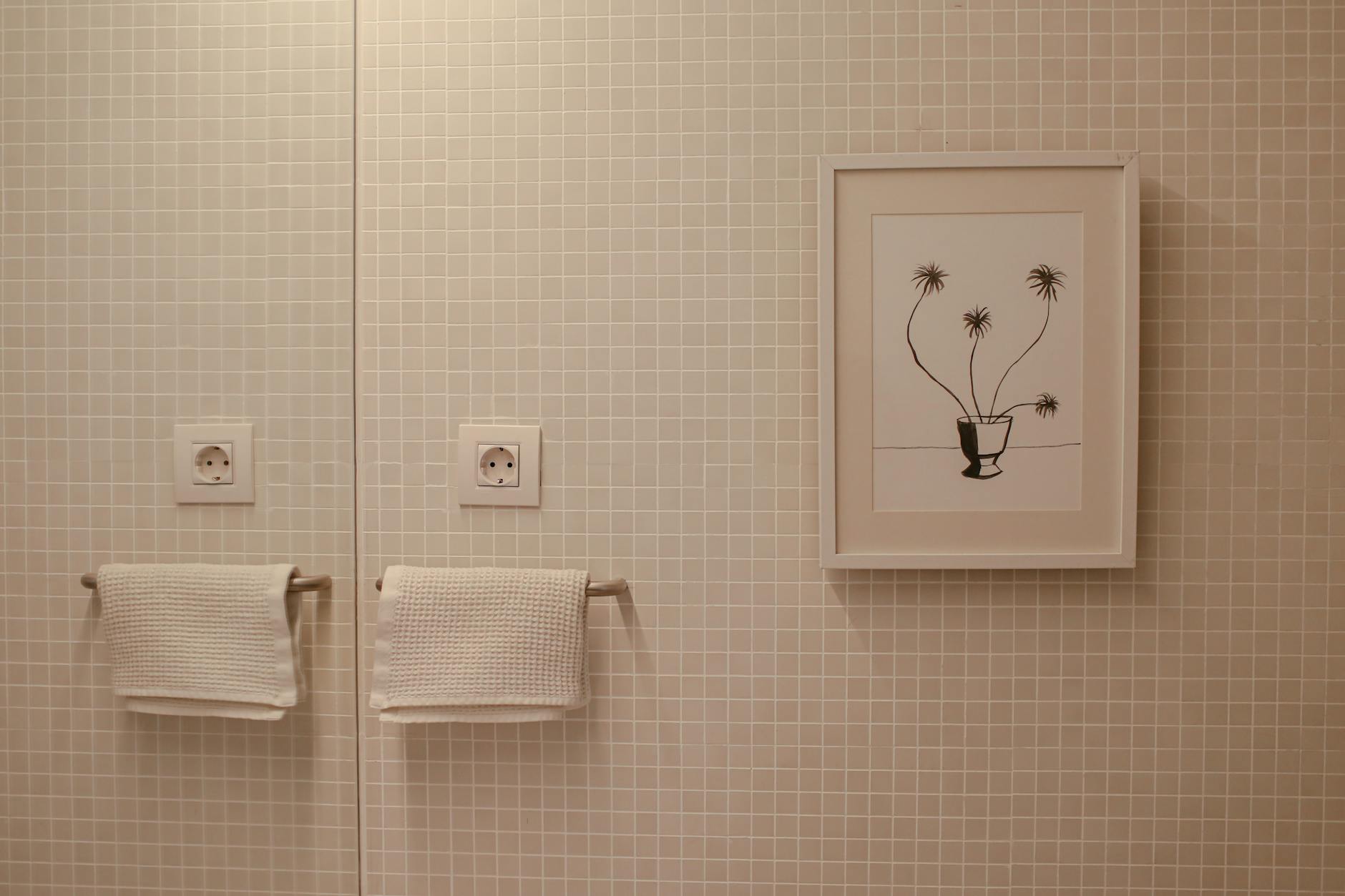
For a wall above a toilet, vanity, or towel rack, the sweet spot is usually an 8x10 or 11x14 inch print. On a larger wall adjacent to a shower or opposite a window, 16x20 gives the space something to rest against without competing with the architecture.
Where to place it:
- Above the toilet: centered, 6-8 inches above the tank
- Above the vanity: if there's no mirror extending to the wall, this is the strongest position in the room
- On the wall opposite the door: this is the first thing you see when you enter. It sets the tone before you've done anything else.
- Near a window: natural light changes how art reads. A print near a window catches different qualities of light across the day in ways artificial overhead lighting rarely achieves.
If you're hanging a single piece, center it optically, which often means placing it slightly above true center on a tall wall. Step back across the room before committing. The piece should feel like it belongs, not like it was placed.
Moisture, Materials, and Framing
Humidity is a real consideration, but it's not the barrier most people make it out to be. The issue isn't that bathrooms are too wet for art. It's that low-quality prints on thin paper warp and yellow when the environment changes with every shower.
A framed matte print can work in bathrooms with adequate ventilation when kept away from direct steam. A framed option adds a clear front protector, but good ventilation and placement away from direct steam still matter. A sealed frame back, rather than an open cardboard backing, keeps the interior stable across temperature and humidity shifts.
What to avoid: foam core mounting, thin paper stock, open-back frames, and frames with exposed MDF edges that absorb moisture at the seam over time.
A well-placed framed print can hang in a normally ventilated bathroom when it stays outside the direct steam path. The investment is in getting the framing right, not in treating the bathroom as off-limits for art altogether.
Rest Here is a print that works particularly well in bathroom spaces. Its clean typography and soft warm background sit quietly without demanding anything from the room, which is exactly what the bathroom wall needs to do.
Putting It Together
The bathroom wall that doesn't feel random has one thing in common: someone made a decision about it. Not a complicated decision, and not necessarily an expensive one. A single piece, chosen for what it holds rather than what it matches. Framed correctly, hung at the right scale, placed where the light finds it.
You don't need a gallery wall in a 60-square-foot room. You need one thing that meets you there, in the first quiet minute of the morning, and says something true.
If you're not sure where to begin, the free print quiz gives you a recommendation based on where you are emotionally, not just what your bathroom looks like. It takes about two minutes and lands somewhere more specific than "spa vibes."
Frequently Asked Questions
What size art works best in a small bathroom?
An 8x10 or 11x14 print tends to hold a small bathroom wall without overwhelming it. Resist the urge to go smaller. A single correctly scaled piece reads as intentional; a cluster of small pieces in a tight space reads as visual noise.
Is it safe to hang art in a bathroom with a shower?
Yes, provided you choose well-framed matte prints and hang them with care. Framed matte prints can handle normal bathroom conditions best when the room is ventilated and the print is kept away from direct steam. Avoid hanging directly in a splash zone, but the rest of the room is suitable for quality framed work.
How do I choose art that doesn't feel random or out of place?
Start with feeling rather than theme. Ask what you want to feel when you're in that space, then look for a piece whose visual language and words speak to that. Color, form, and the emotional territory of the piece matter more than whether it "matches" your towels.
Should bathroom art have words or just images?
Both work, and the right answer depends on the room and the person. Words in bathrooms tend to land harder because you read them every time you're in the space. If you choose words, choose ones you'd actually want to read at 6am, not something that performs for guests.
How many pieces should I hang in a small bathroom?
One well-chosen piece is almost always enough. A larger primary bath with distinct wall zones could accommodate two if they share the same visual family, but the default should be singular: one piece, at the right scale, in the strongest position in the room. Start there. You can always add later. You cannot un-clutter a wall without taking everything down.
You might also enjoy

Written by Haven & Hold