A Gentle Room Reset for After a Hard Week | Haven & Hold
It's Sunday afternoon and the room you came home to is still holding evidence of the week. The throw blanket is balled up where you left it Wednesday night. There is a glass with a ring under it on the nightstand. Three items are on the chair, and none of them live there.
You don't have the energy to clean. You already know this. And you also know, in some quiet part of yourself, that the state of your room is making everything feel just a little heavier than it needs to.
This is a post about what to do with that. Not a cleaning list. Not a total overhaul. A gentle reset, for the week after everything felt like too much.
Why your room feels heavier than you remember leaving it
The connection between your physical environment and your nervous system is real and documented. A 2010 study by Darby Saxbe and Rena Repetti, published in Personality and Social Psychology Bulletin, found that women who described their homes as cluttered or unfinished showed elevated cortisol levels throughout the day. Not just in the evening, and not only when they were actually looking at the mess. The signal was ongoing.
What this means in practical terms is that your room isn't a neutral backdrop. It's an active participant in how you feel. When the environment is cluttered, your body reads it as unfinished work. Your nervous system stays slightly elevated, waiting. Even when you're sitting still, some part of you is still responding to what's around you.
This is why a hard week tends to compound itself. You come home already depleted, and instead of your space absorbing some of that weight, it adds to it. The visual noise accumulates on top of the emotional noise, and by Sunday you're not just tired from the week. You're tired from living inside the evidence of it.
Environmental psychologist Stephen Kaplan described this through what he called Attention Restoration Theory, developed in 1989. Environments with visual complexity and disorder deplete our directed attention. Environments with coherence, calm, and what he called "soft fascination" allow that attention to recover. Your nervous system is not wrong for wanting a clear surface and a quiet wall. It's seeking something it needs.
And you're allowed to give it that. The room can receive you, if you let it.
What a gentle reset actually means
A room reset refers to a focused, intentional return of your space to a baseline of calm. Not a full clean. Not a deep declutter. Just enough to let the room breathe again, and by extension, to let you breathe again inside it. The gentlest version takes fifteen minutes and has three steps: light, one surface, and one anchor.
It's different from cleaning because it isn't trying to address everything. It's trying to address the things your body is already noticing without your conscious involvement. The jacket on the chair instead of hung up. The dishes that migrated to the bedroom. The layer of small objects that built up while you were busy surviving the week.
A gentle reset is sized for the person who is tired. It assumes nothing about your energy levels except that they're lower than you'd like.
If you want a place to start, The Five-Minute Room Reset walks you through it one step at a time, designed for exactly this kind of afternoon.
The reset, in the order that costs the least
When you're running low, you want to begin with the thing that returns the most for the least effort. Not because you're optimizing. Because you're being kind to yourself while still moving. The sequence here starts with almost nothing and builds only as much as you have to give.
Light and air first
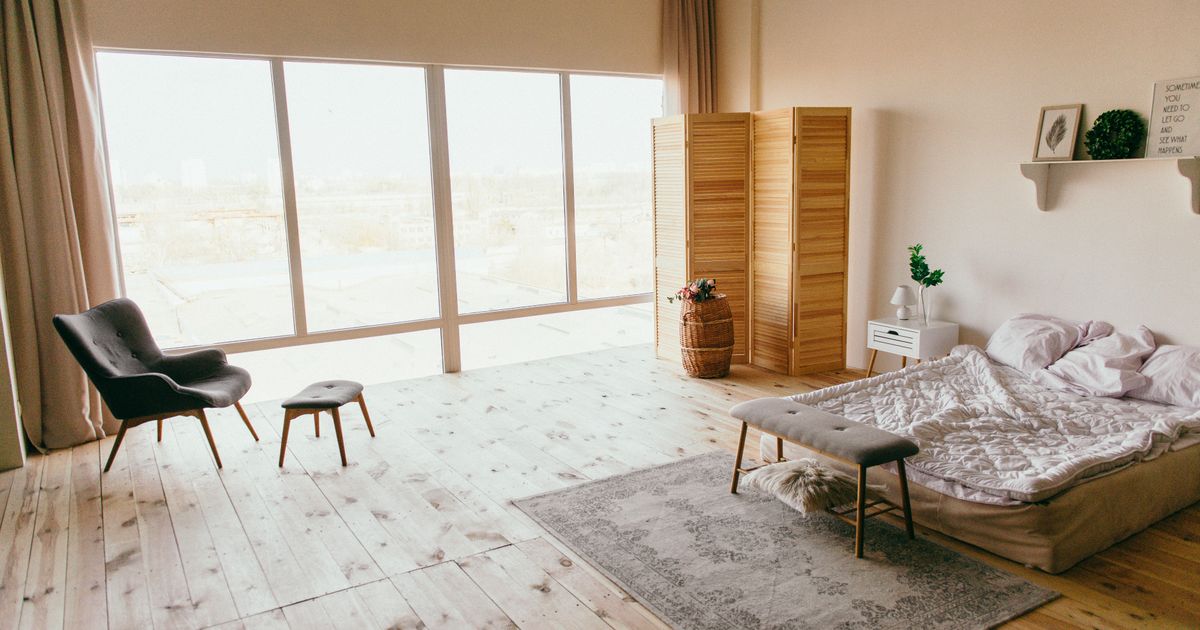
Open something. A window, a curtain, or both. Fresh air and natural light are the fastest ways to change the quality of a room without touching a single object. They require no decisions. They just require the act of opening.
Research supports what you already sense in your body. A 2018 study published in the International Journal of Environmental Research and Public Health found that access to natural daylight improved mood, alertness, and a sense of physical settledness in indoor environments. What's notable is that this effect appeared even with visual access to daylight, not just direct sun exposure. The body responds to the quality of light coming through the window even when you haven't stepped outside.
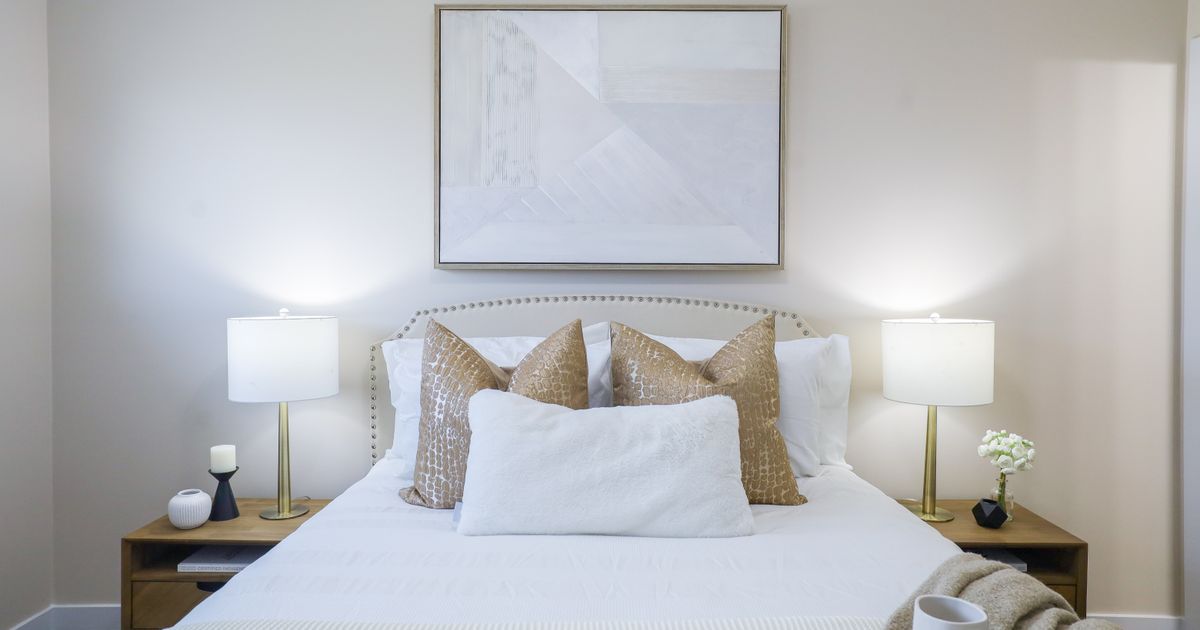
If it's evening, this means switching from overhead lighting to something lower and warmer. The lamp on the nightstand, a lamp on the floor. Ceiling light flattens the room. Layered, warm light holds it.
One flat surface
Choose one. Just one. The table next to your bed, the coffee table, the counter you pass every morning. Clear it completely. Put what's there somewhere else, even if "somewhere else" is a basket in the corner that you'll sort on a different day.
One clear surface gives your eye somewhere to land. And when your eye finds rest, your nervous system often follows. Studies on visual complexity and cognitive load confirm that even small, targeted reductions in visible clutter produce measurable reductions in physiological stress response. You don't have to do the whole room. You have to do one surface.
The room will feel different when you're done. This is not an exaggeration.
One anchor object
An anchor object is something already in your room that signals rest, safety, and return. It's not something you need to buy. It's something you return to its right place, or simply acknowledge and use.
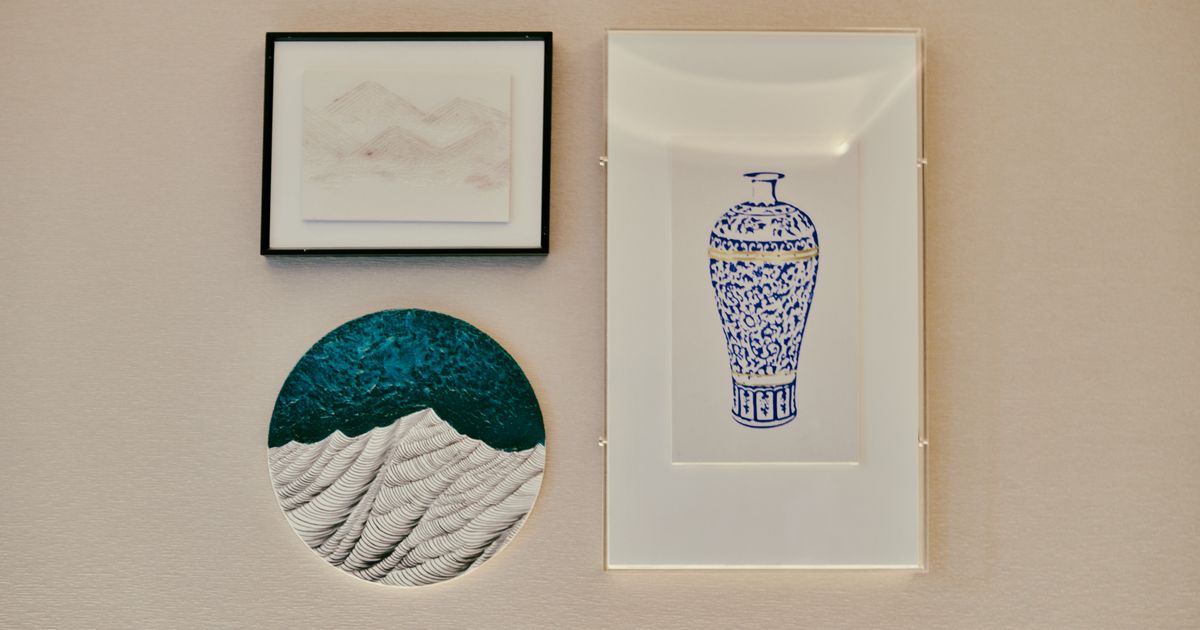
This looks different in every home. For some people it's the blanket folded back at the foot of the bed. For others it's a candle placed back on its spot and lit, just briefly. For some people it's a piece of art on the wall, something they chose with intention, that they look at on the days when looking is all they have.
The act of returning something to its place is an act of return in general. You are coming back to your room. You are letting the room receive you.
What the walls are doing while you rest
Walls are not passive. The research on what therapists call "containment," or the felt sense of being held by a physical space, shows that visual coherence on the walls of a room contributes directly to how safe and settled a person feels inside it. This is part of why deliberate, minimal art appears so often in therapy offices. The walls are doing relational work without saying a word.
If your walls are bare, this is the week you'll notice it. Blank walls during a depleted week can feel like the room has run out of things to offer.
If they hold something you chose with intention, something that signals rest and belonging, you'll notice that too. The Grounding Collection was designed for weeks like this one. Prints like "You are held here" and "Rest here" are not instructions. They're reminders. They hold what you needed to hear, quietly, for as long as you need to hear it.
You don't have to be in the right state to let your walls hold you. That's the whole point.
For a deeper look at how physical spaces participate in wellbeing rather than just reflecting it, therapeutic home design covers the research behind what makes a room feel like shelter.
You don't have to earn this first
One of the quieter reasons a room reset feels hard after a hard week is a belief most people carry without having examined it. The belief that you have to be in a certain condition first. That the apartment needs to be in some acceptable state before you're allowed to rest inside it. That tending to your space is the reward for already having handled everything, not the beginning of the handling.
This is backwards.
You reset the room so that you can rest. Not the other way around. The reset is the first act of tending, not the reward for already having tended.
The same instinct shows up in what drives people to rearrange furniture when they're going through something difficult. The body understands before the mind does that something needs to change in the space. A gentle reset is the quieter version of that instinct. You're not rebuilding the room. You're returning it to a state where it can hold you again.
If you want a practice for the moment you walk through the door rather than the day after, the post on transition rituals for the 10 minutes after you get home pairs naturally with this one.
What's here for you is not another task. It's a way of telling your room that you're back, and letting the room say the same thing back.
Questions people ask about resetting a room after a hard week
How long does a room reset take when you're exhausted?
A gentle room reset takes five to fifteen minutes when it's focused on the three steps described here: light, one surface, and one anchor. It's sized for the window of energy you actually have, not the window you wish you had. Set a timer if that helps, and when the timer stops, you stop.
Is a room reset the same as cleaning?
No. Cleaning addresses hygiene and order throughout a whole space. A room reset is a targeted return to baseline calm in one or two key areas. You're not scrubbing, organizing, or working through a system. You're reducing visual noise and reintroducing one thing that signals rest, and the energy required is proportionally smaller.
What if my room still feels heavy after a reset?
This is more common than most people expect, and it's worth naming. Sometimes the heaviness in the room isn't coming from the room. It's the weight you carried through the door, and the room was the first place it could land. A reset prepares the room to receive you. The exhaling part is still yours to do. Sit down, let your shoulders drop, and let the room hold what it can.
Does what's on the walls matter during a room reset?
More than most people expect. Your eyes move around the room even when you're not consciously directing them. If your walls hold visual noise or objects that don't feel like yours, they add to the depletion. If they hold something chosen with intention, something that signals rest and belonging, they do some of the quiet work for you. This is not a reason to redecorate on a Sunday when you're exhausted. It's worth knowing for the week after this one.
Can I do a room reset even if the whole apartment needs a deep clean?
Yes. The deep clean is for a different day, with different energy. A gentle reset is for this day, with what you have. Doing something small and intentional in the middle of a messy space is not a failure of discipline. It's a recognition that what you need right now is to feel slightly more held, not to solve every problem at once.
Your room doesn't need to be perfect to hold you. It just needs enough of a clearing for the holding to happen.

Written by Haven & Hold