Article: Why Repetition in a Room Feels Restful | Haven & Hold
Why Repetition in a Room Feels Restful | Haven & Hold
You walk into a room and, before you've registered anything specific, your shoulders drop. The pillow on the chair shares a tone with the throw on the sofa. Two prints on the wall speak in the same palette. The curve of the lamp base echoes in the small ceramic on the shelf beside it. Nothing is dramatic. Nothing is reaching for your attention. And somehow, that is exactly why the room holds.
Repetition in a room reads like taste but functions like care. What looks like an aesthetic decision is also a neurological one, a way of signaling to your body that this space is coherent, known, and safe.
What Your Brain Is Actually Doing
The concept worth naming here is called repetition suppression, which refers to the neurological phenomenon where the brain's response to a familiar visual stimulus gradually diminishes across repeated exposures. In a 2018 study published in eLife, researchers found that when the brain encounters a visual pattern it has already processed, the neural response attenuates. The brain softens its attention because it already knows what to expect.
In practice, this means that a room with repeating elements asks less of you. Your nervous system does not need to stay on alert. Every familiar form your eye lands on is one fewer thing to assess. The room is already legible, so you can stop working to read it.
This matters because most people's homes exist in a state of persistent visual novelty, not because they were badly decorated but because life accumulates unevenly. Different textures from different seasons. Colors chosen in different moods. Pieces that each make sense alone but haven't settled into a shared language. Each element is small on its own, but together they add up to a room that keeps asking questions.
A 2010 study published in Personality and Social Psychology Bulletin found that women who described their homes as cluttered or unfinished showed elevated cortisol levels throughout the day, compared to women who described their homes as restorative. The stress wasn't necessarily about mess. It was about visual incoherence. A space that hasn't found its footing.
Repetition is how a room finds its footing.
The Difference Between Repetition and Monotony
This is where most people get stuck. If the same color shows up three times, will the room feel flat? If the same shape recurs in multiple places, will it feel rigid or contrived?
The distinction is worth being clear about: monotony is repetition without variation. It's every element at the same weight, the same intensity, the same scale. A room where every surface is identical doesn't feel restful. It feels static and unresolved.
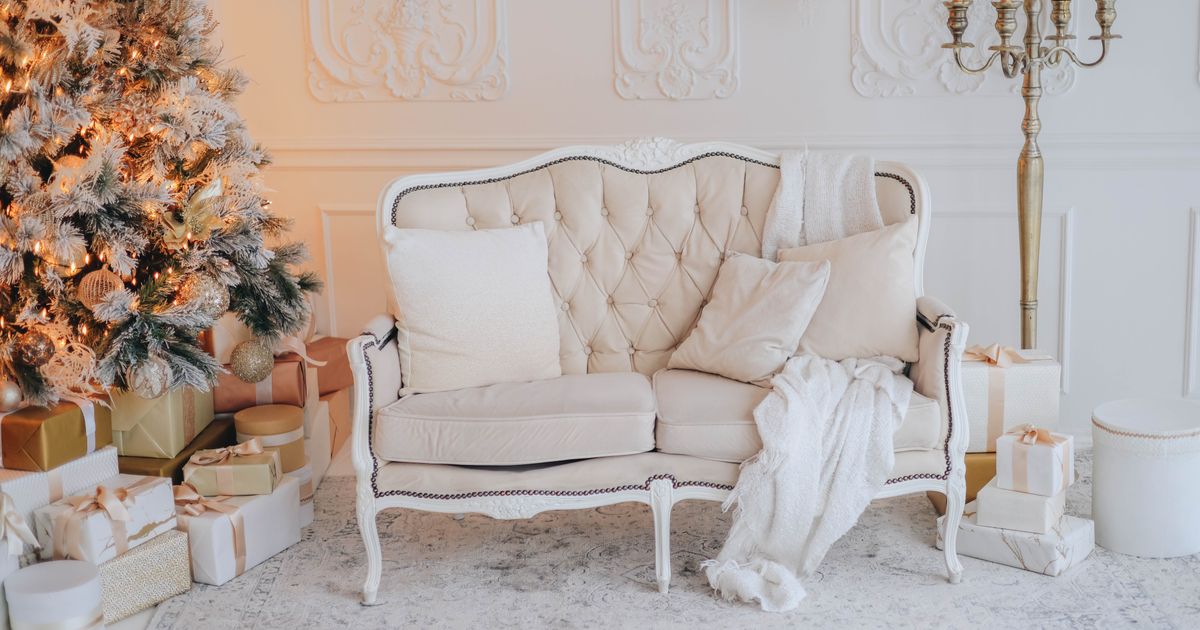
Repetition with variation is different. It's the same warm neutral in three different forms: lighter on the wall, deeper in a textile, warmer in a wood finish. It's the same geometric form at different scales, a circle in a print, a circle in a mirror, and a circle in the arc of a trailing plant. The eye recognizes the family without getting bored. Recognition, rather than sameness, is what creates the feeling of rest.
Think of it like a recurring phrase in music. When you hear that phrase return, your nervous system relaxes into it. It's not boring. It's anchoring. The room is holding a note you already know, and that note says: you have been here before. You know this place.
If you are not sure where to begin, the Sanctuary Style Quiz can help you find the visual language that fits where you are right now.
Where to Start When a Room Has No Repetition Yet
You don't need to redecorate. Most people have more to work with than they realize.
Color is the most accessible starting point. Find one tone that already exists in your room, something you genuinely like, and look for two or three places to bring it back gently. Not match, exactly. Echo. A warm terracotta in a cushion, a candle, and a print with warm undertones in the same family creates a conversation the room begins to hold on its own.
Shape works quietly, often below the level of conscious notice. Circles are particularly effective at creating visual calm because they read as complete and contained. If you already have a round mirror and a round tray, a print with a circular form creates a third point, and your eye traces a quiet path between them. Three is the threshold where repetition reads as intentional rather than accidental.
Material creates continuity the eye understands before the mind names it. Linen in two places, the same wood finish on a lamp and a frame, a texture that recurs across different objects. These tell a story the room tells to itself.
The goal isn't a perfectly coordinated space. The goal is enough coherence that your room stops asking you to figure it out. You can read more about how visual coherence connects to mental wellbeing in the broader piece on therapeutic home design, which looks at the full conversation between your space and your nervous system.
The Wholeness Collection and the Geometry of Return
The Wholeness Collection at Haven and Hold was built around the circle. Not because circles trend, but because circularity is how the mind experiences integration. When you see a complete form, something in you recognizes it as whole. The shape doesn't reach forward or pull away. It returns to itself.
When that form repeats in a room, in a print, in a companion piece, and in the curve of another object, the room begins to hold a coherent point of view. The circle says the same thing in different places, and that repetition builds something cumulative. Not redundancy, but resonance.
This is why pieces like Held gently, held wholly tend to settle into rooms the way they do. The form carries meaning before the words do, and when that form echoes in the room around it, the whole space begins to breathe together.
If you've been thinking about building a wall that holds a point of view across multiple pieces, the post on how to build a cohesive wall art collection one piece at a time is worth reading alongside this one.
Repetition as Attention, Not Effort
The rooms that feel most restful are rarely the ones designed in a single intentional sweep. They're the ones that have slowly accumulated coherence, as the person living in them came to understand what they needed.
This is a kind of attention that takes time. You notice what already repeats. You begin to see which forms and tones show up more than once in the things you've chosen, and you start to ask: what if I let this recur? What if I gave that shape a third home in the room?
The connection between repetition and psychological safety runs deeper than aesthetics. Research on predictability and nervous system regulation suggests that environments with a sense of visual pattern allow the brain to shift from high-alert processing to a quieter resting state. The room is already known. There's nothing to assess. You can set down what you've been carrying.
For days when the whole house feels like too much, the piece on a gentle room reset for the week after everything felt like too much takes a more immediate approach to the same need. And the broader post on why some rooms feel like a hug builds out the psychological framework that explains why repetition lands the way it does.
If you want to carry a little of that coherence through your day, the free Haven and Hold app delivers a single mantra each morning, the same quiet anchoring your room can hold, available between the moments when you need it most.
Frequently Asked Questions
Is repetition in a room the same as minimalism?
Not exactly. Minimalism refers to limiting the total number of elements in a space, while repetition refers to creating coherence among whatever elements are present. A room can hold many objects and still use repetition effectively, as long as shapes, tones, or textures recur across them. The distinction is that repetition creates visual rhythm, while minimalism creates visual restraint.
How many times does something need to repeat before it reads as intentional?
Three is the threshold designers return to most often. One occurrence feels like an accident, two feels like a coincidence, and three reads as a considered decision. When your eye finds the same element a third time, the brain recognizes a pattern and relaxes into it. This applies to color, shape, material, and texture alike.
Can repetition make a small room feel smaller or more closed in?
The opposite tends to be true. Visual complexity, where many different elements compete for attention, makes small spaces feel compressed and chaotic. Repetition reduces the number of decisions the eye has to make and often allows a small space to feel more expansive. When the same color appears in several places, the eye travels across the room rather than stopping at each object individually.
What is the easiest form of repetition to add to a room I already have?
Color is the most accessible starting point. Identify one tone that already exists in your room and find two more places to bring it back. The match does not need to be exact. A family of related tones creates the same visual rhythm, and often reads as more natural and less forced than a precise match.
Does a repeated art print create the same effect as repeated design elements?
A repeated print can establish a visual anchor, but what tends to be more effective is when a print's shape or palette echoes elsewhere in the room. A print with a soft circular form and a warm neutral background creates more lasting coherence when those elements recur in a lamp, a textile, or another object, rather than simply hanging two copies of the same piece side by side.

Written by Haven & Hold