5 Ways Therapists Can Use Quote Art as a Clinical Tool
The session begins the moment your client opens the door.
Before you've exchanged a greeting, before the first pause settles between you, their nervous system is already reading the room. The color of the light. The softness of the furniture. The quiet weight of what's on the walls. This scan happens in milliseconds, and the research confirms what you've probably always sensed: the physical environment shapes the therapeutic frame before a word is spoken. Environmental psychology research places the initial environmental safety assessment within the first 7 to 10 seconds of entering a space, well before any verbal exchange begins.
A 2001 review by Pressly and Heesacker, published in the Journal of Counseling and Development, found that office personalization, comfort, and aesthetics significantly affected clients' first impressions of therapist competence and their initial willingness to disclose personal information. The space isn't a neutral container. It's already working.
So the question worth sitting with is not whether your office decor matters. It's whether the words on your walls are doing work worth doing.
1. As a Conversational Anchor
You've seen it happen. A client arrives mid-spiral, unable to locate an entry point for what they're carrying. Their eyes land on something on your wall. They go quiet in a different way. And then: "I keep looking at that one."
That pause is therapeutic real estate.
Quote art works as a conversational anchor because it externalizes something that would otherwise stay too close to the self to name directly. When a client points to a print that reads "Space for all of you" and says, "that's what I never had growing up," they've just opened a door without having to know how to knock on it. The art holds the thought until they're ready.
This isn't a technique. It's the natural function of meaningful language in a physical space. Words on a wall become a third presence in the room, available for clients to borrow when their own words run out.
The prints that work best for this are the ones that don't tell clients how to feel. They name a territory without prescribing a path. "Held in transition" doesn't instruct. It witnesses. That distinction is everything.
2. As a Visual Map of Therapeutic Frameworks
When you're working within a structured modality, like Internal Family Systems, Acceptance and Commitment Therapy, or somatic experiencing, the language clients learn in session can feel abstract. A visual anchor in the room can hold that language between sessions without any explanation required.
Grounding art, with its stable geometric forms and quiet mantras, speaks directly to the nervous system work many practitioners begin with. A print from the Grounding Collection, hung where a client's eyes naturally rest, can function as a quiet repetition of the co-regulation cue you've already established together. It says: you are held here. The wall says it when you don't need to.
For practices oriented around self-compassion work, the Wholeness Collection offers prints designed around acceptance of incompleteness. "Held gently, held wholly" maps directly to common reframes in compassion-focused therapy. A client working on self-criticism doesn't need to be told what the print means. They'll arrive at it in their own time.
The same holds for growth-oriented work. When someone is in the uncomfortable middle of changing, art that names that exact territory, like "Between chaos and calm" or "Still becoming," gives their experience a form. The room acknowledges where they are without making it an agenda.
If you're thinking through how to make your office walls do more of this quiet work, the Therapy Office Checklist walks you through it, room by room.
3. As a Waiting Room Preparation Tool
The waiting room is where anxiety lives before a session begins. Clients sit with whatever they brought in from the commute, the difficult morning, the conversation they've been rehearsing on the drive over. In most waiting rooms, they're left alone with it.
A holding environment, which refers to a relational context that feels safe enough for genuine emotional work to begin, is the term Donald Winnicott used for what skilled practitioners create before the first word is spoken. That holding doesn't start when you open the door. It starts before that. The waiting room is your first intervention, and most practitioners treat it as an afterthought.
Art that carries soft, grounded language can begin the regulation process before the session itself. A client who spends five minutes with "Safe harbor" on the wall has already started to soften, slightly, before you meet. This is not a substitute for the therapeutic relationship. It's an extension of the intention that relationship carries.
This matters most for clients with acute anxiety, trauma presentations, or high sympathetic nervous system activation. The language of safety, when it appears in a neutral and beautiful form on a wall, carries real weight. It signals: this was chosen with you in mind.
4. As Language Before Language
Clients in early therapy often lack the vocabulary for what they're experiencing. They know something is hard, or confusing, or too much to carry, but the words haven't arrived yet. Quote art can bridge that gap by offering language that feels true before it feels fully understood.
A 2003 review by Devlin and Arneill, published in Environment and Behavior, noted that personalized, thoughtfully decorated therapy spaces were associated with greater perceived therapist warmth and increased client openness. Part of what personalization communicates is that someone chose these things with care, and thought about what you would need before you arrived.
When a client eventually names the print that's been catching their eye, they're often naming something about their own experience. "That one about being between chaos and calm, that's where I've been for months." They've just offered you a frame for the whole session, and they got there themselves.
This is distinct from assigning meaning to the art. The art works precisely because you don't explain it. You let clients come to it. And when they do, it belongs to them.
5. As a Mirror of the Stage of Work
A therapy office doesn't need to hold only one emotional register. Different rooms in a practice, or even different corners of a single room, can carry different territories.
Consider a waiting room that holds primarily Grounding work, with prints oriented around stability and safety. The room says: you are held here before anything else begins. The therapy room itself can carry a wider range of language, from Grounding through Wholeness and into Growth, reflecting the full arc of work that happens there.
For practitioners who occasionally rotate which prints hang where, this becomes a quiet way of marking that the frame of the work is shifting. You don't announce it. The room shifts. Clients notice, sometimes consciously and sometimes not. "Did you always have that one there?" is a session opener that has led somewhere genuinely useful more than once.
There's something honest about an office that evolves alongside the work. A wall that holds "Rest here" during a season of stabilization and "Still becoming" when a client begins to move forward is doing something clinical without calling itself clinical.
Choosing Prints That Do This Quietly
The prints that function best as clinical tools are the ones that don't try to be clinical. They carry emotional territories without prescribing them. They name without instructing. They hold without directing.
Haven & Hold's three collections, Grounding, Wholeness, and Growth, were designed around this principle. Each collection occupies a distinct emotional territory, and prints within the same collection hold together visually and thematically without becoming repetitive. The full collection catalog lets you choose prints across Grounding, Wholeness, and Growth for different spaces in a practice without forcing every room to carry the same emotional note.
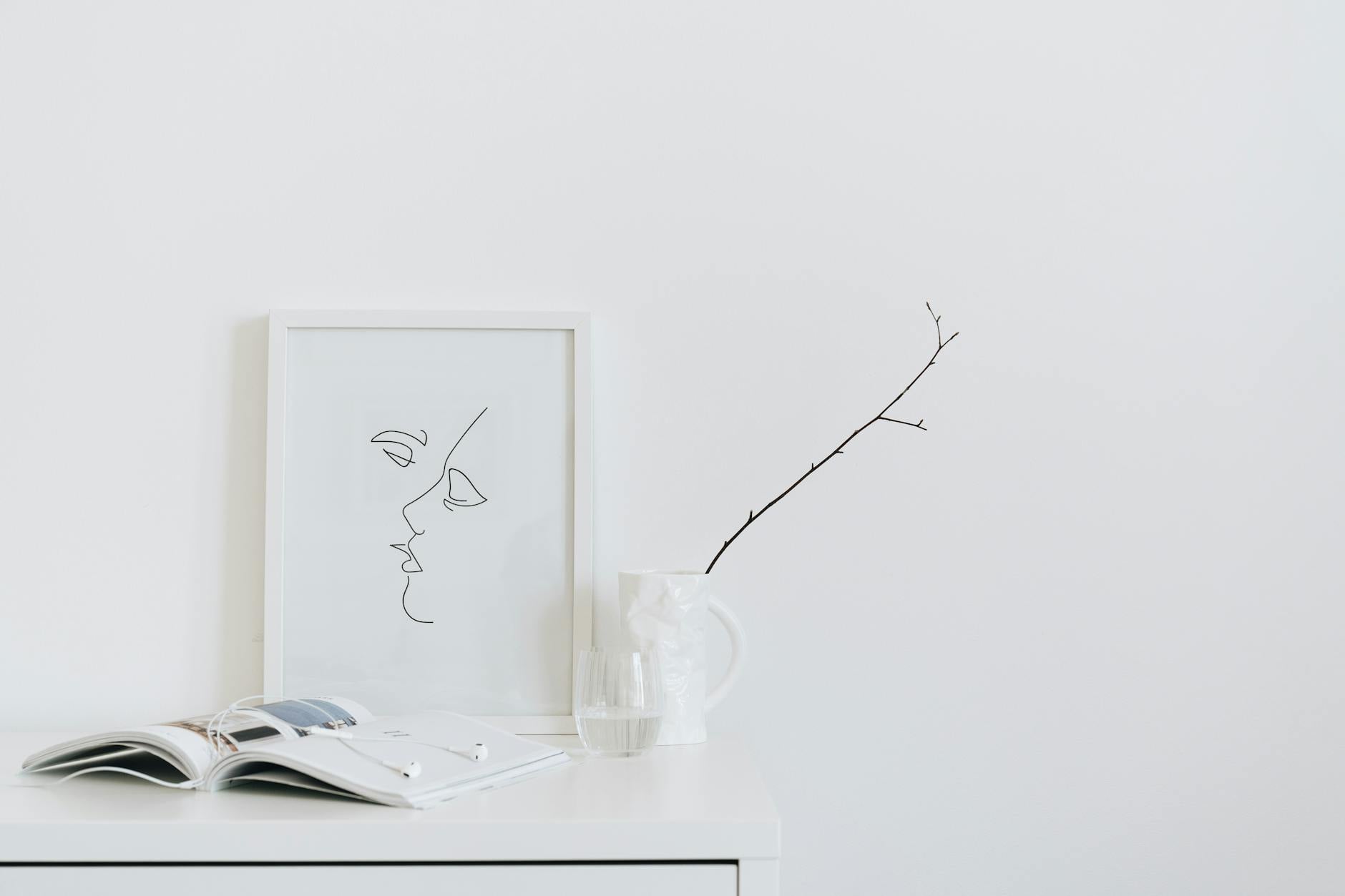
The prints are produced on enhanced matte paper and framed. When hanging, placing the center of the piece at 57 to 60 inches from the floor, which is the standard museum hanging height, puts it at seated eye level for most adults. That's where passive absorption happens most naturally. They're built to hold a professional space, both physically and aesthetically, for years.
If you want to spend time with the collections before choosing, the Growth Collection is a good place to start for practices with a strong developmental or phase-of-life focus. Take your time. The right pieces will make themselves clear.
Frequently Asked Questions
Can a framed quote print actually affect a therapy session?
Yes, and the effect is well-supported by environmental psychology research. Studies on the physical environment in counseling have found that office decor, including art and personal touches, affects clients' initial impressions, their willingness to disclose, and their sense of felt safety. A print doesn't do the work of the therapeutic relationship. It supports the container in which that work can happen.
Where should quote art be placed in a therapy office?
The most effective placement is wherever a client's eyes naturally rest when they're not in direct eye contact with you, typically the wall beside or behind you, or the wall at eye level from their seat. Art placed too high or in a corner that requires effort to see misses the passive absorption that makes it effective. Sit in your client's chair and look around. The right placement is usually obvious from that position.
Should I explain the art to my clients?
In most cases, not explaining it is more useful. The art works precisely because clients arrive at it on their own terms. When you explain a print, you give it your meaning. When you let it sit quietly, clients bring their own. The conversations that begin with "I keep looking at that one" tend to go somewhere more generative than those that begin with "I chose that because..."
What kind of art is appropriate for a therapy room?
Art that names emotional territories without prescribing them. Prints that feel like something a thoughtful person chose rather than something pulled from a generic decor catalog. Abstract or typographic work tends to land better than representational imagery, which can introduce associations you haven't anticipated. Muted, warm color palettes support nervous system regulation rather than activation.
How many prints should a therapy office have?
Fewer than you think. One or two well-chosen pieces do more quiet work than a wall covered in art. Visual density activates the nervous system rather than calming it. A single print placed where a client can sit with it quietly over many sessions often becomes the most meaningful object in the room.
Does the waiting room need different art than the therapy room?
The waiting room benefits from prints oriented primarily toward safety and grounding, since that's where clients are holding their pre-session anxiety. The therapy room can carry a wider range, spanning the full arc from stability through acceptance and into growth, reflecting the range of work that happens there.
You chose this work because you believe the environment you create matters. The words on your walls can be part of that intention, or they can simply be decoration. You already know which one your clients will notice.
If you'd like a structured starting point for thinking through your specific office spaces, the Therapy Office Checklist is there when you're ready.

Written by Haven & Hold