Hallway and Stairway Wall Art: Turning Forgotten Spaces into Meaningful Ones
Your hallway gets you from the front door to everywhere else. Most days you move through it without stopping, without looking, carrying your bag or your thoughts or both. The staircase is just the thing between floors.
And yet: you pass that wall more times a day than you sit in your living room.
This is the part nobody talks about when they write about meaningful home spaces. The focus is always on the bedroom, the reading nook, the kitchen table where the light comes in right. The transitional spaces get skipped, which is exactly why they tend to stay empty. Not empty in a peaceful way. Empty in a way that feels unfinished, like something you've been meaning to get to.
The Spaces You Pass Through Every Day
Transitional space refers to any area of the home that exists primarily to connect other rooms: hallways, entryways, stairwells, and landings. These areas do not invite you to sit or stay. They ask you to keep moving.
That is precisely why they hold more weight than most of us recognize.
Research from the American Society of Interior Designers has documented that transitional spaces function as psychological reset points, where the nervous system reads its first signals about what the next room will feel like. The shift in texture underfoot, the quality of light, and what your eye lands on as you pass all prime your emotional state before you arrive. Your brain is already entering the next room while your feet are still in the hall.
A 2010 study published in Personality and Social Psychology Bulletin by researchers Darby Saxbe and Rena Repetti found that women who described their homes as unfinished or cluttered had measurably higher cortisol levels throughout the day compared to those who described their spaces as restful and settled. The research pointed not to any single room, but to the overall felt sense of the home as tended or untended. Hallways and stairwells are part of that whole.
What this means in practice: the spaces you pass through daily affect your internal state more than most decorating advice acknowledges. They are not a footnote to your home. They are the connective tissue.
Why These Walls Stay Empty
Here is the honest part. You have probably stood in the hallway and thought about it. You know the wall could hold something. And then you kept walking.
The reasoning tends to go like this: it is too narrow, too awkward, too dark. Art feels wasted on a space nobody stops in. Better to put something meaningful in a room where you will actually sit with it.
Look at that logic sideways for a moment. You pass through this space multiple times a day, which means whatever is on that wall makes contact with you multiple times a day. Not in a long, settled way. In a glancing, registering-without-thinking way. That is exactly how environment and habit shape mood: through repetition, not duration.
The other thing that keeps these walls empty is harder to name. It is the feeling that you cannot quite visualize it. A living room has furniture to orient around. A bedroom has the bed as an anchor. A hallway just has the wall, the light, and the fact that it is narrower than you would like. Choosing art for it feels like guessing in the dark.
If you want a place to start, The One-Wall Reset walks you through it, one wall at a time.
What Actually Works in a Narrow Hallway
The most common mistake in narrow hallways is going too small. A single 5x7 print on a long wall reads as apologetic, as if you were not sure you had permission to take up space. The wall does not need filling. It needs anchoring.
For most hallways, one piece in the 11x14 to 16x20 range holds the wall better than a cluster of small frames. The piece can anchor even a tight corridor without overwhelming it, as long as it has enough breathing room above and below. Eight to twelve inches of wall between the frame edge and the ceiling line, and again between the frame edge and the baseboard, is a reliable guide.
If your hallway runs longer than eight feet, two pieces work well: one at each end, creating a quiet call and response. You enter facing one piece and leave near the other. The hallway becomes something you move through rather than something you escape.
Vertical compositions tend to serve hallways better than wide horizontal ones, since they work with the architecture rather than against it. Portrait-oriented prints draw the eye upward and give the corridor a sense of height even when floor space is limited.
One practical note: hallways frequently get less natural light than other rooms. Art with strong contrast between background and text stays legible and present even in dimmer conditions. This matters when the words are the point.
Making a Stairway Gallery Wall Feel Intentional
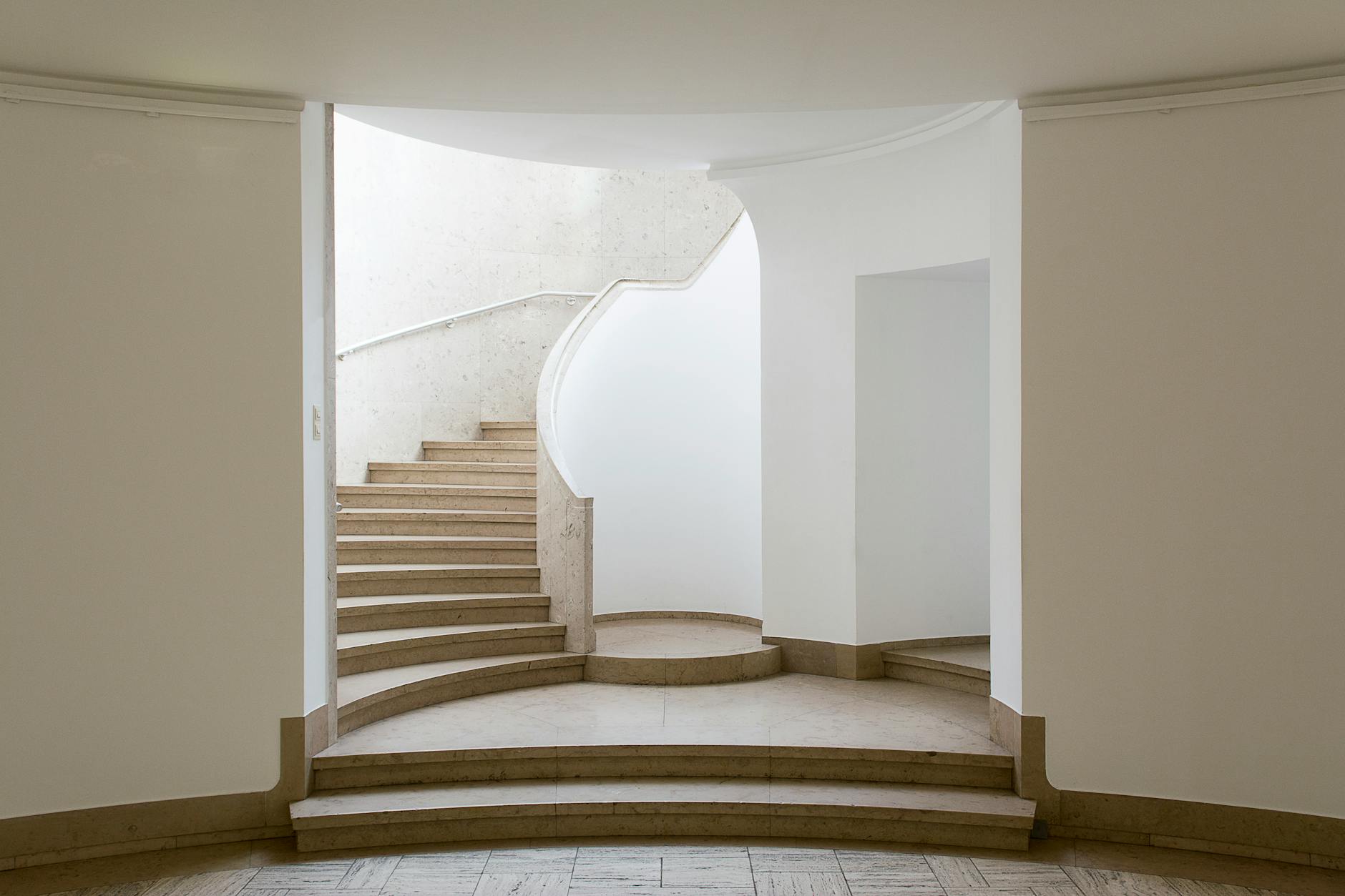
Staircase walls are their own challenge. The rising angle changes nearly every rule that applies to a flat-walled room.
Two approaches work, and they create different feelings.
The first follows the staircase angle. Frames step upward along the wall at roughly the same pitch as the stairs, each one rising an inch or two for every tread. This approach feels dynamic and cohesive, as if the gallery is climbing alongside you. It reads as considered design.
The second keeps all frames at a consistent horizontal level, hung at the same height from the floor regardless of the stair angle beneath them. This approach is quieter and more unexpected. The frames stay anchored while the stairs move through them, creating a feeling of stillness within motion.
For either approach, consistent spacing between frames matters more than consistent frame size. Two to four inches between each piece keeps the arrangement from feeling crowded or scattered. Odd numbers, three or five or seven, tend to settle more naturally on stairwalls than even numbers do. Even groupings can feel too symmetrical for a space that is already asymmetrical by design.
One thing worth mentioning: stairwalls are high-traffic in the sense that every person in the home passes them multiple times daily. What you place there accumulates. Choose with some intention about what you want those words or images doing in the background of your days.
Choosing Art That Holds You in Passing
In a bedroom, you live with a piece over time. You see it at night when you are soft and in the morning when you are still half-awake. It becomes part of the texture of resting. In a hallway, the contact is different: three seconds, perhaps five, as you move past. The art does not have time to speak at length. It has time to say one thing.
This is why words work particularly well in transitional spaces. A short phrase lands in the body the way a complex painting rarely can in a passing glance. The words register. The nervous system responds. And then you have rounded the corner.
What you choose to say matters. A hallway is not a space for decorative text that gestures toward meaning. It is a space where the words you pass by will do something quietly, over the course of weeks and months.
The Grounding Collection holds pieces that work well in transitional spaces: simple, direct, and designed for a glance to carry. "You are held here." "Safe harbor." "Rest here." Words that take a second to read and longer to settle into the body.
For stairwells, where each step is already a small act of moving forward, the Growth Collection has language that suits the motion: "Still becoming." "Between chaos and calm." "Held in transition." Words for what you are climbing toward, named gently and left there on the wall.
Frequently Asked Questions
What size art works best in a narrow hallway?
For most hallways, one piece in the 11x14 to 16x20 range anchors the wall better than a cluster of small frames. Going too small makes the art feel uncertain in the space. Aim for eight to twelve inches of breathing room above and below the frame relative to the ceiling and baseboard.
How do you hang pictures on a staircase wall without making them look crooked?
The most reliable method is to establish a consistent visual center line: hang each piece so its center point sits at the same distance from the stair tread directly beneath it. This creates rhythm regardless of whether you choose to follow the stair angle or keep frames level. A laser level is significantly more reliable than measuring by hand on an angled wall.
How many pieces of art should go in a hallway?
One strong piece outperforms a collection in shorter hallways. In hallways longer than eight feet, two pieces at opposite ends work well. For stairwells, three to seven pieces in an intentional arrangement is the most visually settled range.
Should hallway art match the style of the rest of the house?
Coordination matters more than matching. The art does not need to repeat the same colors or motifs as your living room. It needs to feel like it belongs to the same sensibility: the same emotional register, the same level of care. A hallway piece that speaks a completely different visual language from the rest of the home creates friction rather than flow.
What kinds of prints work best in lower-light hallways?
High-contrast prints, those with a significant difference in value between the background and the text or image, stay legible and visually present even in corridors with limited natural light. Dark backgrounds with light text tend to hold their weight well. Prints that rely on subtle color gradients or pale-on-pale compositions can flatten in dim hallway lighting.
Your hallway has been there the whole time.
You pass it more than you sit in your favorite chair. You glance at its walls more times in a day than you read a page in a book. And it has been waiting, not impatiently, just quietly, for something that earns its place in a space this frequently traveled.
It does not need to be dramatic. It needs to be chosen with some care, hung where your eye lands without thinking, saying something true in the time it takes to walk past.
The right piece will settle in. You will stop noticing it the way you notice something new. Instead, you will feel it: a slight steadiness on the way to the door, a word that registers in the body before the brain catches up.
That is the whole point.
You might also enjoy
Which collection speaks to your season?
Take the 2-minute Sanctuary Style Quiz and find your starting point.
Take the Quiz
Written by Haven & Hold